

FDA report shows casualties from the abortion pill continue to climb
April 21, 2025
By: Carole Novielli, originally published April 9, 2025, LiveAction.org
The U.S. Food and Drug Administration (FDA) has issued a report estimating that the number of women using mifepristone (the abortion pill) to abort their children through December 2024 “is approximately 7.5 million women” since the drug’s approval in 2000.
The report reveals that mifepristone (200mg) killed an additional 1.6 million preborn babies from 2022-2024 — an increase of nearly 103% since 2018. In addition, the FDA reported an additional four women’s deaths associated with the drug since its approval (now a total of 36 , up from 32 reported in 2023). This is an increase of over 27% from two years ago and a 50% increase since 2018.
The drug’s U.S. manufacturers, Danco Laboratories and GenBioPro, are required to report abortion pill numbers to the FDA. While these numbers allegedly represent women who have purchased the drug, there is speculation that they are not representative of the total number of actual abortions, due to alleged stockpiling by women and some states since the Dobbs decision overturned Roe v. Wade.
More women added to death toll
During the COVID-19 pandemic, the Biden administration approved the abortion pill’s expansion to mail-order and brick-and-mortar pharmacies, where it is unlikely that a medical professional will see a woman in person before she takes the drugs. This “no-test” protocol — which requires no ultrasound to determine gestational age or to rule out ectopic pregnancy, along with no blood tests to evaluate any other contraindications — is riskier for women.
“The FDA has received reports of serious adverse events in patients who took mifepristone,” the FDA wrote on its website updated in February 2025. “As of December 31, 2024, there were 36 reports of deaths in patients associated with mifepristone since the product was approved in September 2000, including two cases of ectopic pregnancy (a pregnancy located outside the womb, such as in the fallopian tubes) resulting in death, and several fatal cases of severe systemic infection (also called sepsis),” the FDA’s website (updated February of 2025) states.
However, the FDA adds this caveat:
The adverse events cannot with certainty be causally attributed to mifepristone because of concurrent use of other drugs, other medical or surgical treatments, co-existing medical conditions, and information gaps about patient health status and clinical management of the patient.
A summary report of adverse events that reflects data through December 31, 2024, is here. The FDA has reviewed this information and did not identify any new safety signals. The FDA intends to update this summary report as appropriate.
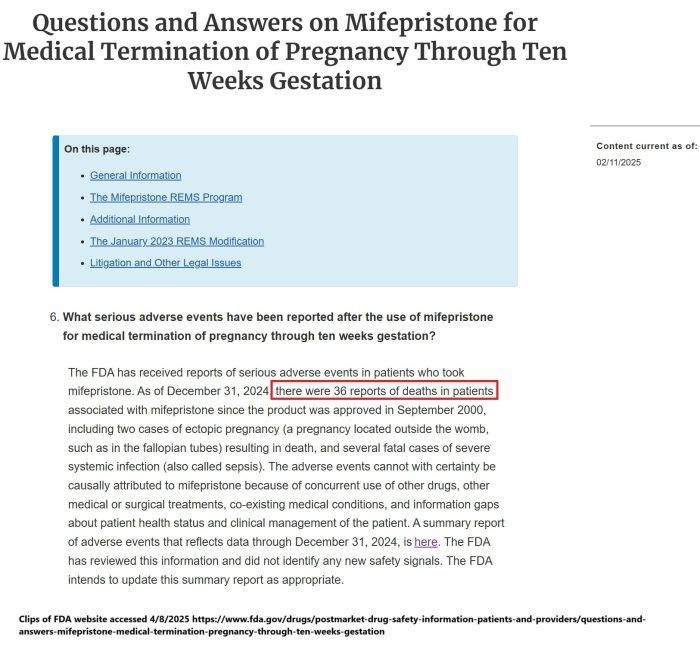
FDA reported 36 deaths assoc. with mifepristone the abortion pill 2000-2024
According to the FDA, “Deaths were associated with sepsis in 13 of the 36 reported fatalities (9 cases tested positive for Clostridium sordellii, 1 case tested positive for Clostridium perfringens, 2 cases had negative blood cultures, and 1 case did not have blood culture data).”
“Ten of the 13 fatal sepsis cases reported vaginal misoprostol use; 2 cases reported buccal misoprostol use; 1 case did not report the route of misoprostol use,” FDA wrote. Misoprostol was approved to be used in a protocol with mifepristone. Due to safety regulations imposed on mifepristone by the FDA, the abortion industry is prescribing misoprostol alone in some instances.
“Twenty-two of the 23 remaining U.S. deaths involved 2 cases of homicide, 2 cases of combined drug intoxication/overdose, 2 cases of ruptured ectopic pregnancy, 2 cases of drug intoxication, 2 cases of suicide,” among other potential associations (seen in the image under adverse events).
“There were 13 additional reported deaths in women in foreign countries who used mifepristone for medical termination of pregnancy,” FDA added.
While the FDA does not specifically state how many mifepristone-related deaths can be attributed solely to abortion, research published in 2022 by the pro-abortion group Advancing New Standards in Reproductive Health (ANSIRH) estimated that 18 of the 32 reported abortion pill deaths — more than half — were “probably or possibly related to the abortion.”
In 2021, ANSIRH claimed that of the 26 reported deaths at that time, 13 (half of deaths) were probably or possibly related to the abortion. In their April 2019 analysis of the FDA’s 2018 adverse events report, ANSIRH claimed 11 of the 24 reported deaths were tied to abortion.
Lack of reporting and blatant deception
Therefore, there is no way to truly know the number or nature of adverse events resulting from the abortion pill after 2016.
Live Action News has documented how bad actors inside the industry have instructed abortion clients present to emergency rooms if experiencing abortion pill complications instead of reporting to the prescriber of the drug. Some have suggested that clients should lie to medical staff and claim they are experiencing natural miscarriages. Abortionist Daniel Grossman took it a step further, unethically suggesting that ER staff should falsify medical documents to cover up abortion pill complications.
This blatant deception not only potentially muddies non-fatal abortion pill complications (which are no longer mandated by the FDA to be reported) but potentially skews the accuracy of any recorded deaths, which could be misattributed to pregnancy or natural miscarriage rather than induced abortion.
However, despite the fact that adverse events are no longer required to be reported, the FDA still noted 4,252 “[c]ases with any adverse event” were reported. They also noted:
- 1,056 hospitalizations (excluding death) with 97 involving ectopic pregnancies
- 606 transfusions due to blood loss
- 422 infections (including 79 classified as severe)
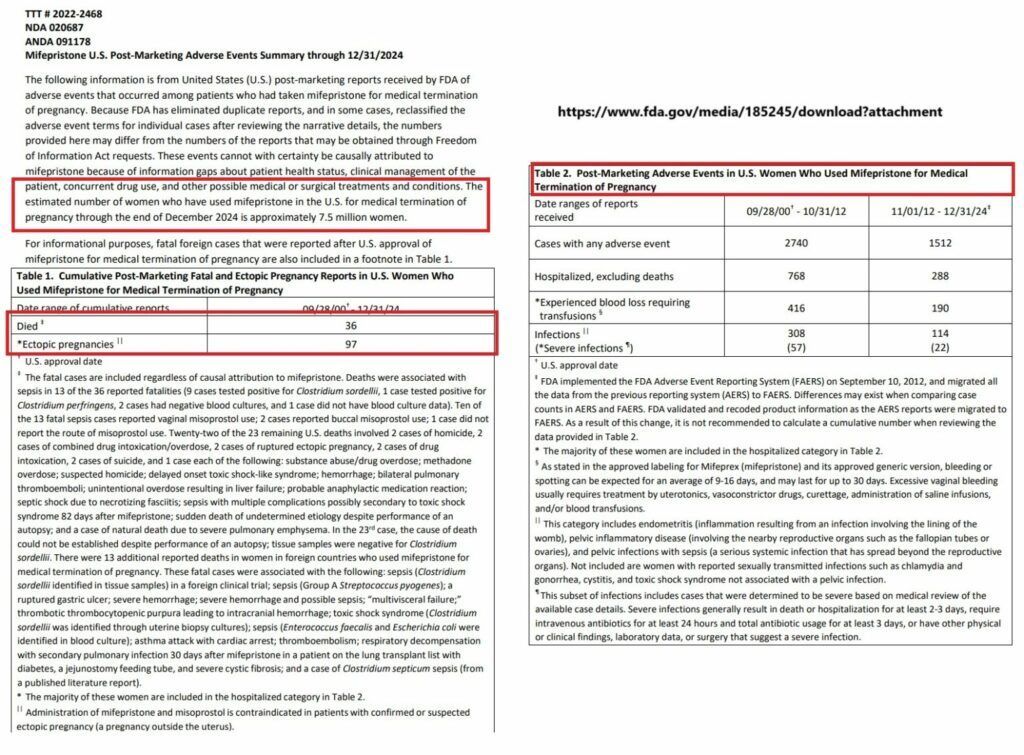
Abortion Pill Deaths and Adverse Events as of December 2024 according to FDA
One life ended every 49 seconds
This means that, in 2023, the abortion pill alone ended the lives of 54,042 preborn human beings monthly, 1,777 daily, 74 hourly, and one every 49 seconds . But this number does not include those that “take place outside of the formal health care system” or which are “mailed to people in states with total abortion bans.”
“While there are no comprehensive data on the number of self-managed medication abortions in the United States, evidence suggests they have been increasing in the past several years. Therefore, the total count of medication abortions nationally is higher than our count of those offered within the formal health care system,” Guttmacher noted.
The black box
While mifepristone contains a “black box” warning regarding serious complications, media outlets often cite pro-abortion “experts” — some with connections to Danco or GenBioPro — who repeatedly claim that the abortion pill is safer than common household drugs.
Pro-abortion groups are even calling for the FDA to approve the drug for use in natural miscarriage — an attempted end-run around the drug’s REMS.
Published percentages for ER visits on mifepristone’s 2023 label indicate that 2.9 to 4.6% of women who take it end up in the emergency room, indicating that abortion pill ER visits could be in the tens of thousands every year. In addition, the FDA’s medication guide acknowledges that as many as seven percent (7%) of women will need surgery after taking mifepristone “to stop bleeding” or to complete the abortion.
A previously-documented Gynuity Health Projects (GHP) telabortion study also found that six percent (6%) of participants (70 out of 1,157) faced complications from the abortion pill, resulting in ER or urgent care visits.
These percentages, against Guttmacher Institute’s updated 648,500 annual abortion pill data from 2023, reveal that each year, 39,000 to 45,400 women may need additional surgery, and 19,400 to over 32,000 women may report to an emergency department after taking abortion-inducing drugs.
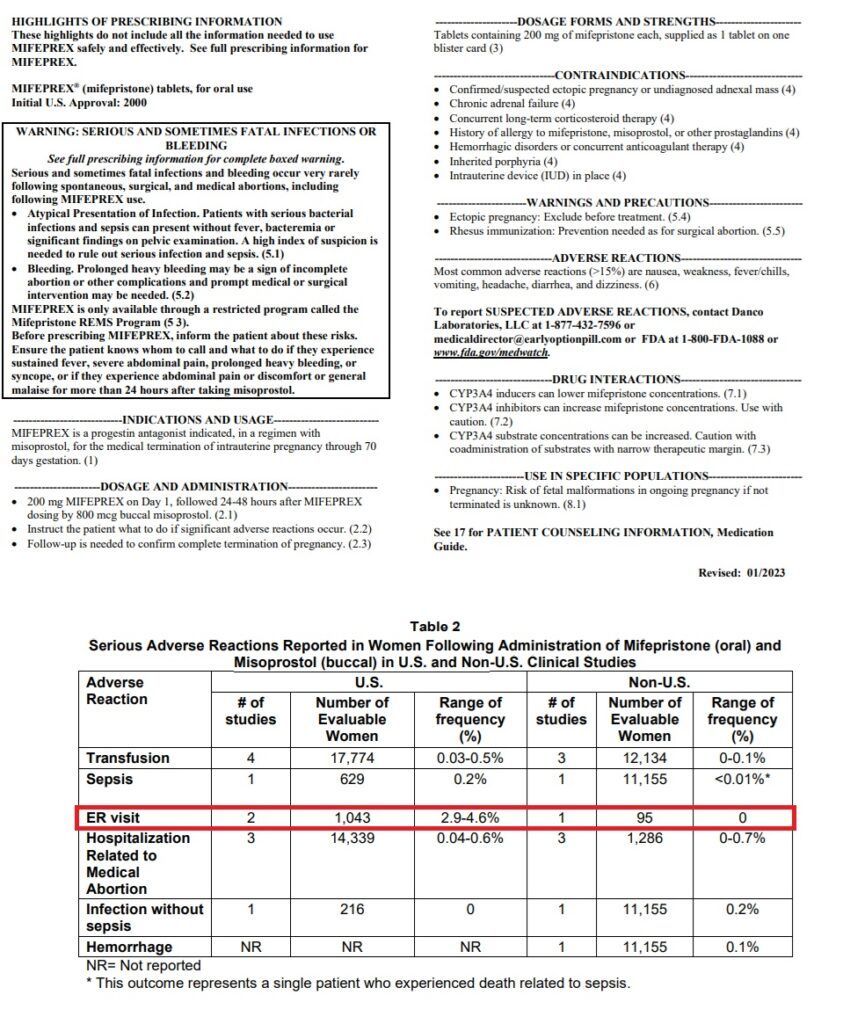
Mifepristone Jan 2023 label shows percentage of women taking abortion pill visit ER
The prescriber agreement (March 2023) for the abortion pill requires prescribers to have the “[a]bility to provide surgical intervention in cases of incomplete abortion or severe bleeding or have made plans to provide such care through others, and be able to assure patient access to medical facilities equipped to provide blood transfusions and resuscitation, if necessary.”
Yet, emergency department staff warned that women are presenting to ERs with undiagnosed ectopic pregnancies after taking abortion pills. Additionally, some state data has indicated complications may be on the rise.
Abortion pill expansions are currently being challenged in the courts by three states, while the full record on the experts who approved the drug in 2000 has yet to be unveiled. Despite legal challenges and the FDA’s continued secrecy around the drug, mail-order abortion pills could be stopped immediately if the Federal Comstock Act, which essentially prohibits the mailing of “any article, instrument, substance, drug, medicine, or thing [that] may, or can, be used or applied for producing abortion[,]” was to be enforced by the Trump Administration.
Carole Novielli has over thirty years of research experience on abortion, Planned Parenthood and eugenics. Her work has been published by many reputable media outlets. As a woman opposed to abortion, Carole is a committed Christian who refuses to be silenced by the main stream media and the nation’s pro-abortion feminist minority.