

Why a viral tweet about maternal mortality shouldn’t be taken as fact
June 12, 2026
By: Nancy Flanders, originally published May 15, 2026, LiveAction.org
A recent post on X regarding maternal mortality has gone viral, but the post uses a source from nearly two years ago that has already been debunked .
Despite this, the misinformation is now making the rounds on social media and has racked up more than 8.7 million views.
Yet, the deception that intentionally killing preborn children is a lifesaving act is what’s behind this push. If the public can be made to believe that killing a million preborn babies every year “saves lives,” then the pro-abortion industry’s propaganda will have been successful.
Key Takeaways:
- Though a viral tweet attempts to portray the idea that maternal mortality is higher in Texas and other pro-life states as a result of pro-life laws, going viral doesn’t make it true.
- The tweet’s follow-up post links to a 2024 Gender Equity Policy Institute (GEPI) study on maternal mortality (with the goal of attempting to prove that intentionally killing preborn babies is a lifesaving act for women).
- The GEPI study purports to show increased maternal mortality in pro-life states, but its smoke and mirrors. The maternal mortality rose during the COVID pandemic, before the Texas Heartbeat Act took effect. After the Heartbeat Act took effect in 2021, the maternal mortality rate declined in Texas.
- Two newer studies show no statistically significant increase in maternal mortality when compared to states with pro-abortion laws.
- Correlation doesn’t equal causation. Other factors such as poverty, increasing maternal age, IVF use, and maternity care deserts may impact maternal mortality.
- The Associated Press admitted that pregnant women tragically die in both pro-life and pro-abortion states from causes deemed “preventable,” with the CDC noting that 80% of pregnancy-related deaths in the U.S. are preventable.
The Details:
The post on X claims: “Pregnancy related deaths in Texas have jumped 56% since abortion was banned.”
A follow-up post links to a study from the Gender Equity Policy Institute (GEPI) on Maternal Mortality in the United States After Abortion Bans. That report claimed, “Mothers Living in Abortion Ban States at Significantly Higher Risk of Death During Pregnancy and Childbirth.”
It made some seriously bold claims, including:
- Women in states with pro-life laws are “nearly 2x as likely to die during pregnancy, childbirth, or soon after giving birth, compared to mothers living” in states where abortion is legal.
- “Maternal mortality fell 21% in [abortion] supportive states post-Dobbs.”
- “Maternal mortality rose 56% in Texas in the first full year of the state’s abortion ban…”
But while perhaps not as catchy as propaganda, here’s the truth:
- The report claims that maternal mortality increased 56% in 2022 (one year), but the data actually comes from a four-year timespan.
- Most of the findings about worsened public health outcomes in pro-life states are due to correlation, not causation — meaning, worse outcomes cannot be directly attributed to pro-life laws, but the data is skewed to make it appear they were.
- In pro-abortion states, the maternal mortality rate fell 20.3% from 2022 to 2023, with GEPI using 2022 as a baseline rather than comparing that to pre-COVID rates, which shows maternal mortality has increased in these states since 2016-2019.
- Two more recent 2026 peer-reviewed studies on maternal mortality show no statistically significant increase in maternal mortality rates in states that enacted strong pro-life laws.
Skewed data
The cited report in the tweet claims, “In the first full year of Texas’s state abortion ban (2022), maternal mortality increased significantly. (10) The maternal mortality rate in Texas rose 56 percent.” But this is not correct; that increase was seen over a timespan of four years, including 2019, 2020, 2021, and 2022 (note that some of these years were the same time frame as the COVID-19 pandemic), not one year. And it rose during COVID before falling again. When looking at the data, its clear that the maternal mortality decreased by 35% after the state’s Heartbeat Act took effect in 2021 (from 43.9 to 28.5).
The data shows:
- Maternal mortality in 2019: 18.3
- Maternal mortality in 2020: 32 (up 75%)
- Maternal mortality in 2021: 43.9 (up 37%)
- Maternal mortality in 2022: 28.5 (down 35%)
The rise was not from the pro-life law, but from COVID-related maternal deaths.
Buried in footnote 10 is this admission:
“All state categories and all states experienced a spike in maternal mortality associated with the Covid-19 pandemic.”
The authors claim the study attempted to correct for this spike in its findings. But looking at the data from Texas, the truth is obvious. When looking at the years further back, it’s clear there has been no significant increase in maternal mortality in Texas.
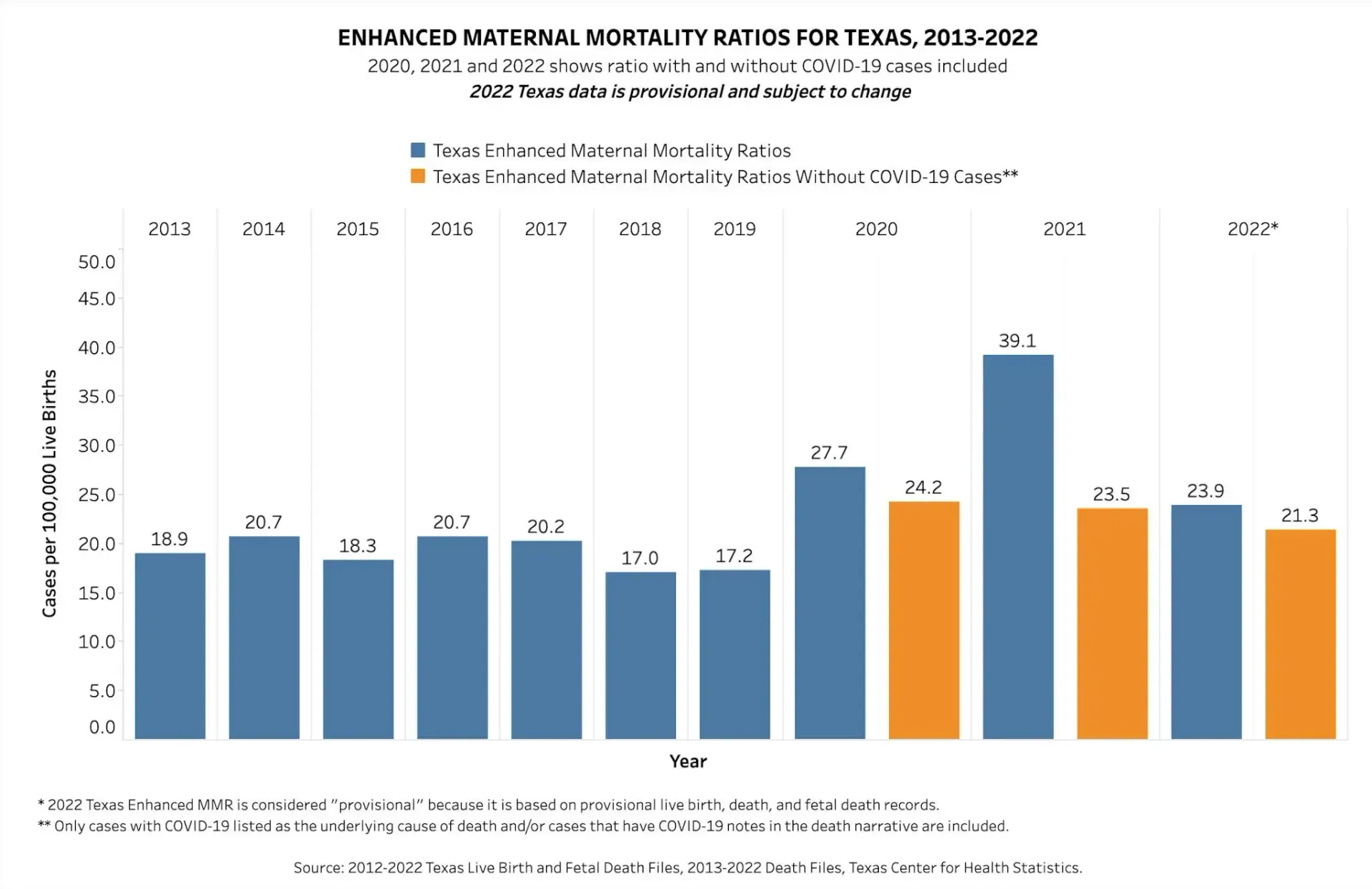
Provisional data from the Texas Department of Health shows:
- In 2016, the maternal mortality ratio (defined as “the number of maternal deaths per 100,000 live births”) in the state was 20.7 deaths per 100,000 live births.
- In 2017, the rate was 20.2 deaths per 100,000 live births.
- In 2018, the rate was 17 deaths per 100,000 live births.
- In 2019, the rate was 17.2 deaths per 100,000 live births.
2019 was the year that Texas enacted its Heartbeat Act to protect preborn babies from abortion beginning at about six weeks. That took effect on September 1, 2019. Then COVID hit.
- In 2020, the maternal mortality ratio in Texas reached 27.7 ( 24.2 , according to the study, with COVID-related deaths removed) per 100,000 live births.
- In 2021, the ratio reached 39.1 deaths per 100,000 live births, but after removing the COVID-related deaths, it was actually 23.5 deaths per 100,000 live births.
- In 2022, the maternal mortality was 23.9 , and, after accounting for COVID-related deaths, it dropped to 21.3 deaths per 100,000 live births. That’s a statistically insignificant difference over 2016, when the rate was 20.7.
This information also reveals that maternal mortality in Texas was declining before COVID and that it is now returning to rates seen pre-COVID.
As for the 35% decrease in maternal mortality in 2022, the year when the strongest pro-life laws went into effect in Texas, Dr. Michael New told Live Action News:
The discussion of Texas is misleading. This current report claims that maternal mortality in Texas increased by 56 percent in 2022. However, their previous report (September 2023) indicated that maternal mortality in Texas increased by 56 percent between 2019 and 2022 (A four-year timespan — not a one-year timespan). Furthermore, their same report (September 2023) found that maternal mortality in Texas actually decreased by 35 percent in 2022. This was the year the Heartbeat Act was enforced, and the strongest pro-life policies were in effect.
“Taking the data at face value, there was no consistent upward trajectory in the maternal mortality rate ,” wrote New. “Furthermore, the year Texas’ strongest pro-life law took effect, maternal mortality actually fell .”
Correlation vs. causation
Another consideration is that there is a difference between correlation and causation. Correlation is not causation, meaning that just because two variables move together (pro-life laws take effect, maternal mortality increases), it does not mean that one caused the other. There are many reasons that maternal mortality may be higher in some states than in others, and they have nothing to do with pro-life laws.
There are many outstanding questions to consider:
- Could increases in advanced maternal age impact maternal mortality? According to the National Center for Health Statistics, “Women ages 40 and older had a maternal mortality rate of 62.3 per 100,000 live births, which is nearly five times higher than the rate for women younger than 25, which was 13.7.” NPR notes that while the birth rate is declining in general in the U.S., it’s actually increasing among mothers aged 40-44. “Between 2013 and 2023, the percentage of births to moms aged 40 to 44 increased by almost 40%,” the article notes. Since risks increase in pregnancies with advanced maternal age, how might this affect maternal mortality?
- Could increases in IVF use impact maternal mortality? From 2013 to 2022, the use of artificial reproductive technology to become pregnant more than doubled , and the number of infants born using these methods increased by 44.5%. In vitro fertilization (IVF) accounts for 99% of ART procedures. According to research, IVF is associated with an increased risk of pregnancy complications, including preeclampsia, hypertension, and gestational diabetes mellitus. Might this affect maternal mortality?
- Could poverty rates impact maternal mortality? As Dr. Michael New explained to Live Action News, “Most states that have enacted strong protections for the preborn are located in the South. Southern states typically have higher poverty rates, which tends to lead to worse public health outcomes.” He then added that it is likely that “the higher poverty rate… is driving the below-average public health outcomes — not the pro-life laws.”
- Could maternity care deserts impact maternal mortality? In addition to higher poverty rates in Southern states where pro-life laws are more common, much of the South is also more rural. Maternity care deserts are significantly affecting pregnant women in these states. Between 2010 and 2022, several Southern states, including Alabama and Mississippi, saw more than 60% of their rural hospitals operating without maternity services. According to Stateline, “Rural states saw the most profound losses. The states with the highest percentage of all hospitals lacking obstetrics by 2022 were North Dakota (73%), Oklahoma (63%), West Virginia (62%), Louisiana (60%), South Dakota (60%) and Mississippi (60%).” In Texas, 17 OB/GYN units closed between 2011 and 2021, according to the UTHealth School of Public Health.
“Preventable deaths” among pregnant women happen everywhere
Pro-life states are not alone in experiencing preventable maternal deaths.
- The Associated Press admitted that pregnant women tragically die in both pro-life and pro-abortion states from causes deemed “preventable.”
- Preventable pregnancy deaths occurred under Roe , and they are still happening in pro-abortion states.
- The number of women dying in the U.S. from pregnancy-related causes more than doubled in the 20 years between 1999 and 2019 — during the reign of Roe v. Wade — according to a study published by the Journal of the American Medical Association.
- A comparison between pro-abortion California and pro-life Georgia showed that despite having the same number of maternal deaths (113) from 2018 to 2020, California had the higher percentage of maternal deaths determined to be preventable.
Newer studies show no significant increase in maternal mortality
Two new studies have emerged since the 2024 Gender Equity Policy Institute’s skewed look at maternal mortality.
⦿ The JAMA Network ‘s peer-reviewed study published in April 2026, which examined “12 ,993 pregnancy-associated deaths from 2018 to 2023,” showed “ no significant overall increase in pregnancy-associated mortality was found in ban vs nonban states . State-specific estimates were heterogeneous, but none reached statistical significance.”
Researchers were clear:
“This cohort study found that abortion bans were not associated with significant overall or state-specific increases in pregnancy-associated mortality in the early post-Dobbs period…”
The JAMA study found that maternal mortality rates are declining in all states.
According to Dr. New’s review of the study, “Since enacting its Heartbeat Law, Texas saw its maternal mortality rate drop by 2.4 percent. Other states with strong pro-life laws saw their maternal mortality rate drop by 3.3 percent.”
He added that “this analytically rigorous JAMA Network Open study which analyzed data from all 50 states and the District of Columbia provides strong evidence that pro-life laws do not increase the maternal mortality rate.”
Results showed that from 2018 to 2023, pregnancy-associated mortality dropped by 9.8% in pro-abortion states. In states with pro-life laws (excluding Texas), there was a 2.4% decline in pregnancy-associated mortality. Texas itself saw a decline of 3.3%. The researchers explained (emphasis added):
Synthetic control analyses yielded an estimated difference of 5.1 (95% CI, −7.9 to 18.2) pregnancy-associated deaths per 100 000 live births, which was not statistically significant. Overall estimates for pregnancy-related mortality (−2.0; 95% CI, −11.5 to 7.5), maternal mortality (−3.0; 95% CI, −10.2 to 4.2), and nonobstetric causes (1.2; 95% CI, −7.3 to 9.7) were likewise not statistically significant. State-specific estimates were heterogeneous, but none reached statistical significance. Covariate-adjusted models yielded similar results.
⦿ The 2026 AJPH study , a publication of the American Public Health Association, reported, “There was no detectable increase in maternal mortality” among the 14 states that implemented pro-life laws by the end of 2022.
The study showed:
- Across all states , the maternal mortality rate rose slightly from 18 per 100,000 live births in 2016-2019 to 18.5 in 2023 after hitting a high of 32.6 in 2021, likely due to COVID.
- In pro-abortion states, the maternal mortality rate rose from 15.4 in 2016-2019 to 16.2 in 2023. (That’s an increase, not a decrease, as the Gender Equity Policy Institute claimed in its 2024 study.) Rather than using the 2019 rate as it did to claim a maternal mortality increase in pro-life states, GEPI used 2022 as the baseline for pro-abortion states. According to the AJPH study, this would show 20.3% decrease in maternal mortality in pro-abortion states. However, from 2016-2019 to 2023, the maternal mortality actually increased very slightly in abortion friendly states.
- In states with pro-life laws , excluding Texas, the maternal mortality rate decreased from 26.6 in 2016-2019 to 23.7 in 2023.
- In Texas, the maternal mortality rate increased from 20.3 in 2016-2019 to 24.3 in 2023 (a 19% increase). From 2019 (17.2) to 2023 (24.3), it increased by about 41%, largely thanks to COVID, but it decreased from a high of 44.0 in 2021 . GEPI used 2019 as the baseline for Texas; if it had used 2022 for a baseline, as it did for pro-abortion states, it would have shown a 13.2% decline in maternal mortality for Texas from 28 to 24.3.
As explained by New, “The only [GEPIT] finding that is slightly interesting is that they claim maternal mortality went down by 21 percent in the 24 states where abortion is legal. The authors also acknowledge that maternal mortality decreased by 16 percent overall. Back of the envelope calculations would strongly suggest that maternal mortality also fell in states with pro-life laws — so there is no public health disaster there. That said, even in this section the authors of the report do not provide any data about the specific timeframe of these maternal mortality declines.”
Zoom Out:
Data from outside the United States can offer evidence that pro-life laws actually allow for a lower maternal mortality rate.
As previously reported by Live Action News, “It is worthwhile to note that Poland has the most restrictions on abortions, yet has the lowest rate of maternal mortality. The same was once true for Ireland, prior to the country’s legalization of abortion in 2019.”
Why It Matters:
The best maternal mortality rate would be zero , and improving maternal health is a serious issue on which the U.S. should be focusing. But claiming abortion improves maternal mortality is a lie that could lead to further maternal deaths.
Abortion is the direct and intentional killing of preborn children and carries significant risks to the women who choose it, both immediately and in the years that follow. Damage to the cervix and uterus from abortions can cause complications in future pregnancies that increase risks to women’s health.
Most maternal deaths are preventable — not by intentionally killing preborn children, but by actually treating the source of the problem and not delaying care.
According to the Centers for Disease Control and Prevention (CDC), 80% (or four in five) of pregnancy-related deaths in the U.S. are determined to be “ preventable .” It reports that the “leading underlying causes of pregnancy-related death” are:
- Mental health conditions (including deaths to suicide and overdose/poisoning related to substance use disorder) (23%)
- Excessive bleeding (hemorrhage) (14%)
- Cardiac and coronary conditions (relating to the heart) (13%)
- Infection (9%)
- Thrombotic embolism (a type of blood clot) (9%)
- Cardiomyopathy (a disease of the heart muscle) (9%)
- Hypertensive disorders of pregnancy (relating to high blood pressure) (7%)
Claiming that pro-life laws cause such deaths ignores the real issues of medical neglect, mental health struggles, and substance abuse.
The Bottom Line:
The lie that pro-life laws are causing women’s deaths is meant to cause emotional shock and horror among Americans to increase support for abortion, which is the direct cause of death for millions of innocent children.
Nancy Flanders is Associate Editor for Live Action News.